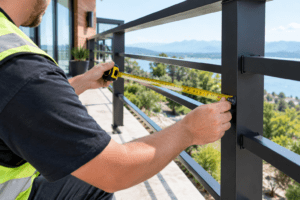
Railings don’t fail all at once. They deteriorate gradually with a little more corrosion with each hurricane season and a little more movement each year until either an engineer flags them in an inspection report or, worse, something actually gives way. For condominium boards and property managers, knowing what to look for before that happens is the difference between a planned capital project and an emergency special assessment.
After more than 30 years manufacturing and installing railing systems for South Florida condominiums, we’ve seen these warning signs repeatedly in buildings of every size from waterfront high-rises to mid-rise condominium communities. Identifying them early allows boards to plan replacements on their own timeline, rather than reacting to inspection reports or unexpected repairs.
Here are the five signs that consistently show up before a railing system needs full replacement rather than repair.
1. Visible Rust, Corrosion, or Paint Failure at the Base or Posts
Surface staining is common and often cosmetic. What boards need to watch for is corrosion at the base plates, posts, or anchor points, the structural connection points where a railing actually holds its load. Rust bleeding through the powder coat, bubbling paint, or white oxidation streaks on aluminum are early warning signs that the protective coating has failed and the metal underneath is being exposed to salt air.
Why it matters: Once corrosion reaches the anchor points or base plates, it’s no longer a cosmetic issue it’s a structural one. This is exactly the kind of condition milestone inspection engineers are trained to flag, since Florida’s post-Surfside inspection requirements explicitly cover the condition of balconies, railings, and their connections to the primary structure.
2. Any Wobble, Movement, or Give When Leaned On
A properly installed and structurally sound railing should not move when someone leans against it. Any perceptible wobble, flex, or looseness at the base even slight indicates a compromised connection, whether that’s anchor pull-out, base plate corrosion, or deteriorating concrete at the mounting point.
Why it matters: This is the single most direct life-safety indicator on this list. A railing that moves under normal use is not meeting the load requirements it was designed for, regardless of how it looks. Any resident-reported wobble should trigger an inspection by a licensed professional immediately, not a maintenance work order.
3. Your Building Is Approaching (or Has Reached) Its Milestone Inspection Age
Under Florida’s Senate Bill 4-D and its amendments, condominium and cooperative buildings three stories or taller must complete a milestone structural inspection at 30 years from the certificate of occupancy or 25 years in many coastal jurisdictions and every 10 years after that. These inspections specifically evaluate the condition of balconies and railings, along with their structural connections.
Why it matters: If your building is within a few years of its milestone inspection deadline, proactively assessing railing condition before the formal inspection gives your board time to plan and budget rather than reacting to a report on a legal deadline and potentially facing daily fines or board liability for non-compliance if repairs aren’t scheduled promptly afterward.
4. The Railings No Longer Meet Current Code — Even If They’re Structurally Fine
Building codes evolve. Picket spacing requirements (generally no gap large enough to allow a 4-inch sphere to pass through), minimum railing heights, and load requirements have all been updated over past decades. A railing installed 25–30 years ago may be structurally intact but non-compliant with today’s code which becomes a real problem the moment a permit is pulled for any adjacent renovation, or when insurance underwriters request current compliance documentation.
Why it matters: Code non-compliance can complicate refinancing, insurance renewal, and unit sales even when the railing itself isn’t failing. It’s worth having a licensed contractor confirm current code compliance as part of any broader building assessment, not just checking for visible damage.
5. Repair Costs Are Becoming Frequent and Cumulative
Every railing system needs occasional maintenance that’s normal and expected, as we cover in our guide to railing maintenance and durability. What’s not normal is a pattern of recurring repairs on the same sections, escalating maintenance costs year over year, or a maintenance team that’s spending increasing time on railing-related work orders.
Why it matters: At a certain point, the cumulative cost of ongoing patch repairs exceeds what a full replacement would have cost, while still leaving the building with an aging system that will eventually need replacement anyway. Tracking railing-related maintenance costs over a 2–3 year window gives your board the data needed to make that comparison objectively rather than deferring the decision indefinitely.
What to Do If You’re Seeing These Signs
- Get a professional assessment, not just a maintenance team opinion especially for signs #1, #2, and #4, which require a trained eye to evaluate correctly.
- Loop in your milestone inspection or SIRS timeline if your building is approaching either deadline, so railing replacement can be scoped and budgeted alongside any other structural findings rather than as a separate, later project.
- Get a proper field survey and quote, not an estimate based on a single sample balcony our guide on common and costly railing project mistakes covers why this step matters so much for budget accuracy.
- Decide on system type early. If you’re replacing railings anyway, it’s worth evaluating whether glass, picket, or a hybrid approach makes the most sense for your property see our comparison of glass vs. picket railings and property value.
H2: FAQ
How do I know if my condo’s railings are a safety issue or just cosmetic? Surface rust and faded paint are typically cosmetic. Any movement or wobble when leaning on the railing, or rust visible at the base plates and anchor points, should be treated as a potential structural issue and inspected by a licensed professional promptly.
Does my building need new railings before its milestone inspection, or can we wait for the report? Either approach is valid, but proactively assessing railing condition before your milestone inspection deadline gives the board more time to budget and schedule the work on your own timeline, rather than reacting to a report with fixed compliance deadlines and potential fines attached.
Can old railings just be repaired instead of fully replaced? Sometimes isolated corrosion or damage can often be repaired. But once corrosion reaches structural connection points, movement is present, or the system no longer meets current code, full replacement is typically more cost-effective than repeated patch repairs over time.
Who should inspect condo railings for safety issues? A licensed engineer, architect, or an experienced railing contractor familiar with Florida’s structural and wind-load code requirements. For any building approaching its milestone inspection age, this should be coordinated with the professional engineer handling that inspection.
Concerned About the Condition of Your Railings?
Whether your building is approaching a milestone inspection or you’re seeing signs of corrosion, movement, or recurring repairs, our team can help evaluate your railing system and recommend the most practical path forward.
Call us at (561) 877-4109 or email [email protected] to schedule a property assessment.